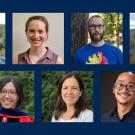
Three professors from the University of California, Davis, have been elected as members of the National Academy of Sciences. They are among 120 new members and 23 international members announced by the academy May 2. Members are elected in recognition of their contributions to original research. Membership in the academy is considered one of the highest honors a scientist can achieve.
The final round of the UC Davis Grad Slam had a flurry of PowerPoint slides, a giant deck of cards and a stuffed monkey, but in the end the top prize went to someone talking about genetic “ghosts.”
An internal circadian clock controls the distinctive concentric rings of flowering in sunflowers, maximizing visits from pollinators, a new study from plant biologists at the University of California, Davis, shows. The work was published Jan. 13 in eLife.
A sunflower head is made up of hundreds of tiny florets. Because of the way sunflowers grow, the youngest florets are in the center of the flower face and the most mature at the edges, forming a distinctive spiral pattern from the center to the edge.
An international team has succeeded in propagating a commercial hybrid rice strain as a clone through seeds with 95% efficiency. This could lower the cost of hybrid rice seed, making high-yielding, disease resistant rice strains available to low-income farmers worldwide. The work was published Dec. 27 in Nature Communications.
Female infants are born with several million immature egg cells, or oocytes. Over the course of the reproductive years, a few hundred of them will develop into mature eggs for potential fertilization. Because of this extended maturation process, the oocytes of humans and other mammals are vulnerable to both developmental exposures and the aging process.
When you’re experimenting with water, electricity and live animals, a lot can go wrong if you’re not careful. And no one knows more about that than Rachael Bay and her research team.
They study human-induced changes in the environment and evolutionary processes — things like climate change, coral bleaching and bird migration. And when you’re doing that kind of work — handling chloroform one day and blood samples the next — you want to make sure you’re not cutting corners.
The college is very pleased to welcome the newest members of its broad and diverse faculty. With appointments in the Departments of Evolution and Ecology, Plant Biology and Microbiology and Molecular Genetics, the new faculty are poised to make an impact on their respective areas of expertise, and on the classroom and laboratory experience of our students across the college.
Anya Brown
Assistant Professor Department of Evolution and Ecology
The U.S. Department of Energy is funding a project at the UC Davis College of Biological Sciences to study the function of genes that regulate growth and wood formation in poplar trees. The three-year, $2.5 million project is led by Nitzan Shabek, assistant professor in the UC Davis Department of Plant Biology together with Andrew Groover at the USDA Pacific Southwest Research Station in Davis and Justin Walley, Iowa State University.
Fertility is finite for mammalian females. From birth, females possess a limited number of primordial follicles that are collectively called the ovarian reserve. Within each follicle is an oocyte that eventually becomes an egg. But with age, the viability of the ovarian reserve decreases.
“Despite its fundamental importance, our understanding how the ovarian reserve is established and maintained remains poor,” said UC Davis Professor Satoshi Namekawa, Department of Microbiology and Molecular Genetics.