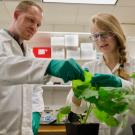
Growing up in Germany, Philipp Zerbe knew he wanted to be a biologist by the time he was 5 years old. In fact, he scribbled the decision to become a ‘Biologe’ down on paper, which his parents kept—and gifted to him upon becoming an assistant professor of plant biology in the College of Biological Sciences at UC Davis in 2014.
Neuroscience Ph.D. student Lindsay Cameron and other researchers at UC Davis are actively exploring drugs capable of restoring health in the brains of those with mood disorders. Some dark horse candidates are psychedelics like LSD, psilocybin and DMT.
The combination of a big population, good genes and luck helps explain how a species of fish in Texas’ Houston Ship Channel was able to adapt to what normally would be lethal levels of toxins for most other species, according to a study to be published May 3 in the journal Science.
A parasitic amoeba that causes severe gut disease in humans protects itself from attack by biting off pieces of host cells and putting their proteins on its own surface, according to a study by microbiologists at the University of California, Davis.
The Bodega Marine Laboratory’s white abalone program has millions of new additions following its most successful spawning ever at the University of California, Davis, facility.
Scientists have successfully sequenced the coast redwood and giant sequoia genomes, completing the first major milestone of a five-year project to develop the tools necessary to study these forests’ genomic diversity.
In his new lab at UC Davis, Assistant Professor Lucas Smith, Department of Neurobiology, Physiology and Behavior, investigates how the accumulation of scar tissue affects muscle mechanics. His aim is to develop therapies that alleviate neuromuscular disorders and restore healthy muscle regeneration.
While it only accounts for 3 percent of cancers nationwide, 91 percent of pancreatic cancer patients succumb to the illness within five years of diagnosis. Assistant Professor Chang-il Hwang developed miniature organ models that allow him to study pancreatic cancer from its earliest stages with the hope of improving diagnosis.
The genome—the complete suite of an organism’s DNA and genes—is likened to a blueprint for life. On the surface, this comparison provides some understanding of a biological concept. But according to some scientists, it misses the mark.